AHC 2026
Embodied relationality: Beyond unconditional positive regard

This page will stay posted for 3 months after the conference. Please let me know if you notice any problematic language or concepts. I hope to work in collaboration to continue unlearning harmful ways of being.
In the counseling relationship, embodied relationality means that the counselor’s and client's living bodies are mutually shaping each other in real-time. The counselor’s presence is already affecting how the client's experience unfolds, and the client's presence is simultaneously affecting the counselor’s organismic responses, creating a unified relational field rather than two separate people who then interact. This mutual influence happens at the pre-verbal, bodily level: how the therapist shows up in this moment is freshly determined by their entire history as it's being affected by this particular client's presence right now, and vice versa. The quality of this interaffecting determines whether the client's implicit knowing can carry forward into fresh occurring (healing, new meaning) or becomes blocked, making the therapeutic relationship itself the living ground where change either happens or doesn't.
“A different ‘we’ makes a different ‘me’.”
- Preston (2020) summarizing Gendlin
THE PROBLEM
No counselor wants to block their client’s growth, but some accidentally do.
Words are never neutral tools. Rogers’ approach uses words and counselor attitudes as tools of change, but language and counseling are systems steeped in hegemonic values of Western culture. As a language-driven modality ingrained with Rogers’ core concepts, counseling can accidentally constrain or impose upon a client’s growth, especially if their background or identities differ from mainstream culture.
THEORETICAL BACKGROUND
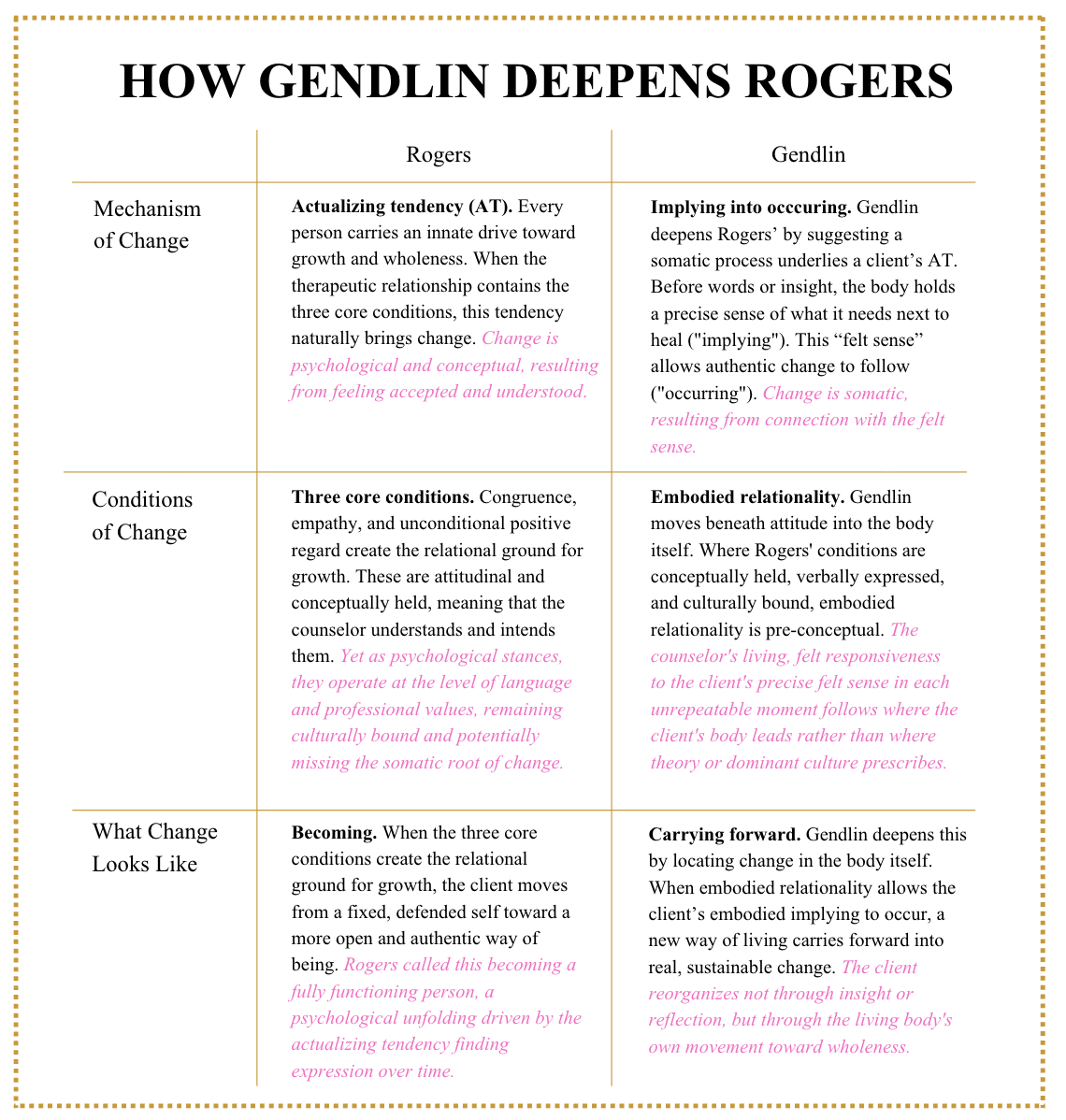
Gendlin deepens Rogers’ theory by revealing that a client’s embodied felt sense is the critical mechanism of change.
Where Rogers locates change in the client’s psychological experience of being heard and accepted (through congruence, empathy, and unconditional positive regard from the counselor), Gendlin identifies implying into occurring as the core mechanism of actualization: the client’s body holds a pre-verbal, precise, felt sense of what their living process needs next to be well or flourish (“implying”). When the client can connect with their felt implying, what’s being implied can occur (“occurring”), and the client’s living process can carry forward into change.
The felt sense arises from the client's own living body, prior to language, culture, or interpretation, and so carries its own authority independent of anything the counselor brings into the room.
For Rogers, a good outcome is the client’s psychological unfolding toward a more authentic self as a result of counselor attitudes. For Gendlin, a good outcome is the client’s living process carrying forward, as a result of embodied relationality from the counselor.
The counselor’s task: “Be the kind of interaction that makes the client better”
- (Gendlin in Lynn Preston’s 2015 video).
CORE CONCEPT
If the client’s change is bodily, the counselor's presence must be as well.
Because Rogers' three core conditions are conceptually held, verbally expressed, and culturally bound, they risk imposing the counselor's cultural and professional values into the therapeutic relationship. Alternatively, Gendlin asserts that because change originates in the client's own body, the counselor’s task becomes being present with their whole body, meeting the client's precise, bespoke felt sense in a way that makes the client’s implying safe enough to carry forward into occurring. Beyond unconditional positive rgard, client change requires an embodied relationality.
SOCIAL JUSTICE IMPLICATIONS
If change originates in the client's pre-verbal, pre-cultural body rather than in the counselor's culturally mediated presence, then counseling must be inherently deferential to the client's own experience, making it a more equitable and culturally responsive practice.
CLINICAL TAKEAWAYS
Meet the client's precise, bespoke felt sense moment-to-moment, rather than leading with pre-determined attitudes or language.
Invite words or non-verbal expressions that arise from the client's own felt sense, not from professional frameworks or interpretations.
Examine how expert positioning and dominant frameworks risk silencing the implying that counseling intends to carry forward.
PRESENTER POSITIONALITY
I am a white, English-speaking, American, gender and sexually expansive person socialized female, living with invisible disability and chronic illness, raised low-income.
LAND ACKNOWLEDGEMENT
We acknowledge and pay tribute to the original inhabitants of this land. The City of New Orleans is a continuation of a multicultural Indigenous civilization on the Mississippi River known for thousands of years as Bulbancha, a Choctaw term meaning “a place of many tongues.” The Choctaw, Houma, Chitimacha, Biloxi, and other Native peoples have lived on this land since time immemorial, and the resilient voices of Native Americans remain an inseparable part of our local culture. (credit to New Orleans Public Library)
REFERENCES
Gendlin, E. T. (1964). A theory of personality change. In P. Worchel & D. Byrne (Eds.), Personality change (pp. 100–148). John Wiley & Sons.
Gendlin, E. T. (1981). Focusing (2nd ed., new rev. instructions). Bantam Books
Gendlin, E. T. (2012). Implicit precision. In Z. Radman, (Ed.). Knowing without Thinking: Mind, Action, Cognition and the Phenomenon of the Background. Palgrave MacMillan.
Gendlin, E. T. (2017). A process model: Studies in phenomenology and existential philosophy. Northwestern University Press.
Lynn Preston Focusing Relational Psychotherapy. (2015, September 18). Eugene Gendlin, Ph.D. on the theory of focusing-oriented psychotherapy [Video]. https://www.youtube.com/watch?v=xXp11zpK95M
Preston, L. (2020, May 21). Unleashing the Philosophy of the Implicit [Webinar]. Zoom. Zoom.us.
Ratts, M. J., Singh, A. A., Nassar-McMillan, S., Butler, S. K., & McCullough, J. R. (2016). Multicultural and social justice counseling competencies: Guidelines for the counseling profession. Journal of Multicultural Counseling and Development, 44(1), 28–48. https://doi.org/10.1002/jmcd.12035
Rogers, C. R. (1961). On becoming a person: A therapist's view of psychotherapy. Houghton Mifflin.
Schoeller, D., & Dunaetz, N. (2018). Thinking emergence as interaffecting: Approaching and contextualizing Eugene Gendlin's Process Model. Continental Philosophy Review, 51(3), 1–28. https://doi.org/10.1007/s11007-018-9437-9
Sue, D. W., Sue, D., Neville, H. A., & Smith, L. (2020). Counseling the culturally diverse : theory and practice (Eighth edition.). John Wiley & Sons, Inc.