
AMHCA 2026 Poster
Embodied approaches: Integrating Focusing-Oriented Therapy with Gestalt, IFS, and EFT
Presented by:
MacPherson J. Worobec
Department of Counseling, Seattle University
Graduate Student
Kathleen H. Driscoll, Ph.D., LPCC (CA), LCMHC (NC), NCC, ACS, BC-TMH
Department of Counseling, Seattle University
Assistant Clinical ProfessorThis page will stay posted for 3 months after the conference. Please let me know if you notice any problematic language or concepts. I hope to work in collaboration to continue unlearning harmful ways of being.
Poster session description: This presentation explores how Focusing-Oriented Therapy (FOT) enhances cultural humility in Gestalt, IFS, and EFT through somatic pathways that resist Western dominance and honor diverse ways of knowing. Through applied case examples, attendees gain practical knowledge for centering clients' lived, embodied experiences and transforming counseling relationships into sites for liberation.
“When it is felt, it changes”
-Gendlin (1981)
WHAT IS F.O.T.?
The Felt Sense: The body knows before the words arrive.
Developed by Eugene Gendlin, a student of Carl Rogers, from 1960s research on the mechanism of successful outcomes in therapy, Focusing-Oriented Therapy (FOT) teaches clients to attend to their inner "felt sense"; their body's vague, unclear, physical sense about a situation that can be truly felt, but is not yet named or known (Gendlin, 2017; 1981). Rather than analyzing or interpreting, the counselor gently guides clients to listen inward and let meaning unfold at its own pace and in the client’s own terms.
CORE CONCEPT
FOT: A helpful addition to embodied modalities.
The felt sense is a knowing less shaped by the rules, norms, and systems of oppression that govern how clients are permitted to speak and feel, especially through language. By helping clients access this meaning before it's shaped into theoretical or cultural terms, FOT enriches Gestalt, IFS, and EFT, deepening cultural humility and equity. Talk therapy assumes verbalization is most expressive, but there are many ways to be effective without words.
SOCIAL JUSTICE IMPLICATIONS
Centering on the client's own felt, bodily experience affirms the client as the authority on what that experience means to them. This is both an approach and an ethical commitment to meeting clients on their own terms. Woven into somatic oriented approaches, FOT strengthens the cultural responsiveness of each approach, honoring every client's lived, embodied knowing so they can be understood without first translating themselves into other frameworks.
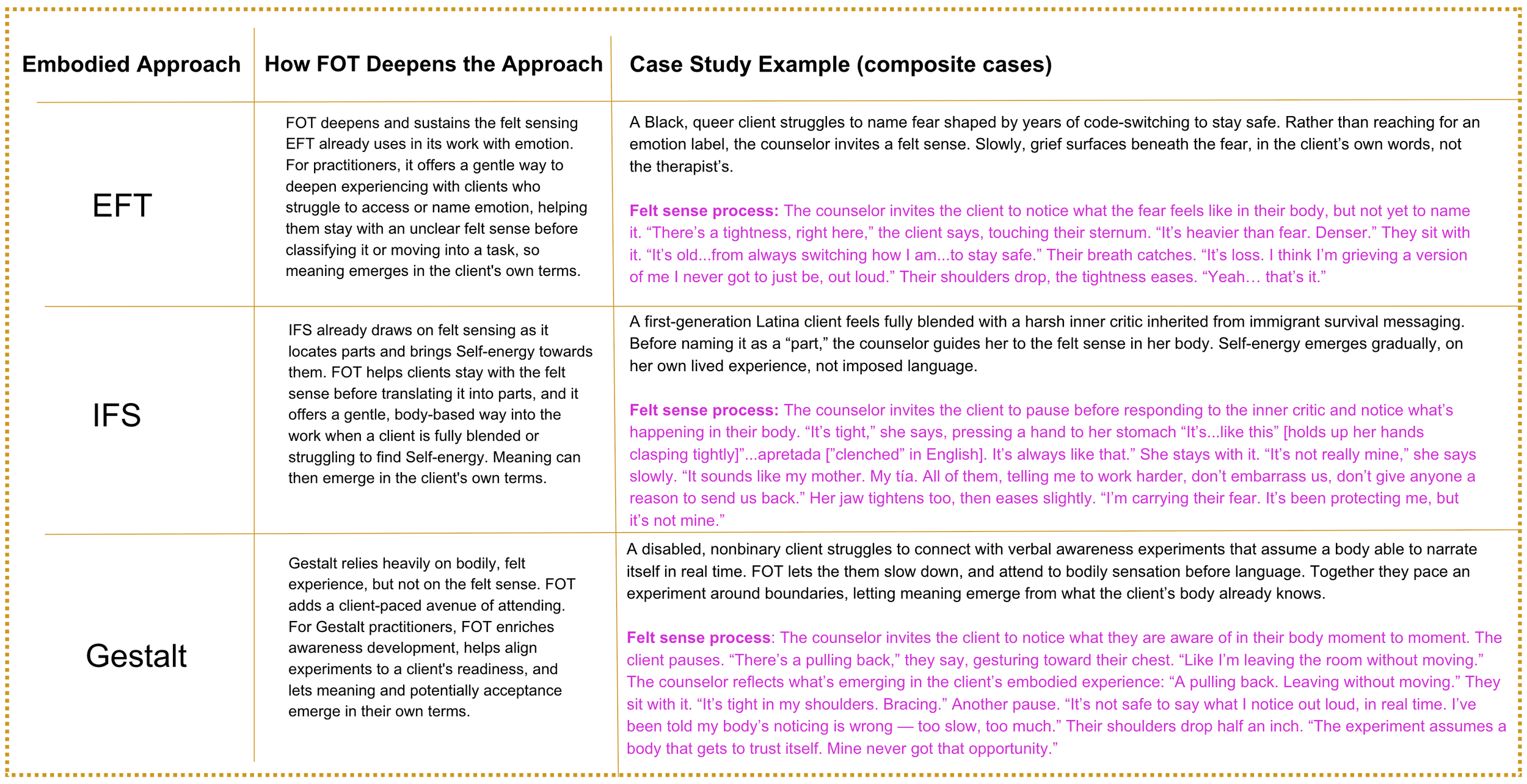
HOW FOT DEEPENS CULTURAL RESPONSIVENESS IN EFT, IFS, AND GESTALT
CLINICAL TAKEAWAYS
Inviting the felt sense before naming it lets clients author their own meaning, deepening cultural humility across diverse populations.
When clients seem blended, stuck, or unable to verbalize, slow down, and invite bodily sensation before reaching for language or offering labels.
Felt-sense work loosens the bias toward verbal fluency as a marker of progress, widening access across language, ability, and culture.
PRESENTER POSITIONALITY
MacPherson: I am a white, English-speaking, American, gender and sexually expansive person socialized female, living with invisible disability and chronic illness, raised low-income.
Kathleeen: I am a white, English-speaking, American, straight, cisgender, able-bodied woman.
LAND ACKNOWLEDGEMENT
We acknowledge and pay tribute to the original inhabitants of this land - the Multnomah, Wasco, Cowlitz, Kathlamet, Clackamas, Bands of Chinook, Tualatin, Kalapuya, Molalla, and many other tribes who resided along the Columbia River.
A donation has been made to the Native American Youth and Family Center (NAYA) Scholarship Fund for the presentation of this poster at the 2026 AMHCA conference on these lands.
REFERENCES
Brenner, E. G., Schwartz, R. C., & Becker, C. (2023). Development of the internal family systems model: Honoring contributions from family systems therapies. Family Process, 62(4), 1290–1306. G
Brubacher, L. L. (2025). Stepping into emotionally focused therapy: Key ingredients of change (2nd ed.). Routledge.
Deacon, S., & Davis, J. (2001). Internal family systems theory: A technical integration. Journal of Systemic Therapies, 20, 45–58. G
Friedman, N. (2004). Eugene Gendlin's approach to psychotherapy: An awareness of "experiencing." Annals of the American Psychotherapy Association, 7(1), 23–27.
Gendlin, E. T. (1964). A theory of personality change. In P. Worchel & D. Byrne (Eds.), Personality change. John Wiley & Sons.
Gendlin, E. T. (1981). Focusing (2nd ed.). Bantam Books.
Gendlin, E. T. (2017). A process model: Studies in phenomenology and existential philosophy. Northwestern University Press.
Greenberg, L. S. (2004). Emotion-focused therapy. Clinical Psychology & Psychotherapy: An International Journal of Theory & Practice, 11(1), 3–16.
Greenberg, L. S. (2010). Emotion-focused therapy: An overview. Turkish Psychological Counseling and Guidance Journal, 4(33), 1–12.
Grindler Katonah, D., Grafanaki, S., Krycka, K. C., & McDonald, M. V. (2023). Transformational focusing experiences: A thematic analysis of memoirs. The Journal of Humanistic Psychology, 63(3), 381–409.
Johnson, S. M. (2008). Hold me tight: Seven conversations for a lifetime of love. Little, Brown Spark.
Johnson, S. M. (2019). The practice of emotionally focused couple therapy: Creating connection (3rd ed.). Routledge.
Krycka, K. C. (2006). Thinking at the edge: Where theory and practice meet to create fresh understandings. Indo-Pacific Journal of Phenomenology, 6(1), 1–10.
Lobb, M. S., & Wheeler, G. (2015). Fundamentals and development of Gestalt therapy in the contemporary context. Gestalt Review, 19(2), 1–24.
Madison, G. (2014). The palpable in existential counseling psychology. Counseling Psychology Review, 29(2), 25–33.
Mermin, D. (1974). Gestalt theory of emotion. The Counseling Psychologist, 4(4), 15–20.
Perls, F., Hefferline, R. F., & Goodman, P. (1951). Gestalt therapy: Excitement and growth in the human personality. Delta Books.
Raffagnino, R. (2019). Gestalt therapy effectiveness: A systematic review of empirical evidence. Open Journal of Social Sciences, 7, 66–83.
Schoeller, D., & Dunaetz, N. (2018). Thinking emergence as interaffecting: Approaching and contextualizing Eugene Gendlin's process model. Continental Philosophy Review, 28, 123–140. https://doi.org/10.1007/s11007-018-9437-9
Schwartz, R. C. (2013). Moving from acceptance toward transformation with internal family systems therapy (IFS). Journal of Clinical Psychology, 69(8), 805–816. https://doi.org/10.1002/jclp.22016
Schwartz, R. C. (2021). No bad parts: Healing trauma and restoring wholeness with the internal family systems model. Sounds True.
Yontef, G., & Jacobs, L. (2005). Gestalt therapy. In R. J. Corsini & D. Wedding (Eds.), Current psychotherapies (7th ed., pp. 299–336). Brooks/Cole-Thomson Learning.